Political Science as a Discipline
Definition and Scope:
Political science is the academic discipline that studies the theory and practice of politics and government. It explores the structure, processes, and activities associated with the governance of societies, as well as the analysis of political behavior, political systems, and political thought. The scope of political science encompasses a wide range of topics including the formulation and implementation of public policies, the functioning of political institutions, the behavior of political actors, and the complex interplay between individuals, groups, and the state.
Subfields:
- Political Theory: Focuses on the philosophical foundations of politics. It involves the study of concepts such as justice, power, authority, liberty, and democracy. Political theorists analyze and critique political ideas and ideologies from both historical and contemporary perspectives.
- Comparative Politics: Examines political systems and behaviors across different countries. It aims to identify patterns, similarities, and differences in political processes, institutions, and cultures. This subfield helps in understanding how different political systems operate and their impacts on societies.
- International Relations: Studies the interactions between countries, including diplomacy, conflict, trade, and international organizations. It explores theories of international relations, global governance, security, and the impact of international actors on global issues.
- Public Administration: Focuses on the implementation of government policies and the management of public programs. It covers topics such as bureaucratic functioning, public sector management, organizational theory, and policy analysis.
- Public Policy: Analyzes the process of policy-making and the effectiveness of public policies. It involves evaluating the design, implementation, and outcomes of policies in various areas such as health, education, environment, and welfare.
- Political Methodology: Concerns the techniques and methods used to study political phenomena. This includes quantitative and qualitative research methods, statistical analysis, and the development of models to understand political behavior and institutions.
Importance and Relevance:
- Understanding Governance: Political science provides insights into how governments function, how public policies are formulated, and how power is distributed and exercised within societies.
- Informed Citizenship: By studying political science, individuals become more informed and engaged citizens, better equipped to participate in democratic processes and understand their rights and responsibilities.
- Policy Development: Political scientists contribute to the development of effective public policies by analyzing policy impacts, advising policymakers, and advocating for evidence-based decision-making.
- Conflict Resolution: The discipline helps in understanding the root causes of political conflicts and devising strategies for conflict resolution and peace-building.
- Global Awareness: Political science fosters a deeper understanding of global issues, international relations, and the impact of global events on national and local politics.
Interdisciplinary Connections:
Political science intersects with various other disciplines such as economics, sociology, law, history, and psychology. For example:
- Economics: Political economy examines how political institutions and processes affect economic policies and outcomes.
- Sociology: Political sociology explores the relationship between society and politics, including the social bases of political behavior and the impact of social movements.
- Law: Constitutional law and administrative law are crucial for understanding the legal frameworks within which political systems operate.
- History: Historical analysis provides context for understanding contemporary political systems and events.
- Psychology: Political psychology investigates the psychological underpinnings of political behavior, including voter behavior, leadership, and decision-making.
Career Opportunities:
Graduates in political science can pursue diverse career paths including:
- Government and Public Service: Roles in local, state, and national government agencies.
- International Organizations: Positions in the United Nations, World Bank, and other international entities.
- Non-Governmental Organizations (NGOs): Work in advocacy, policy analysis, and program management.
- Academia and Research: Teaching and research positions in universities and think tanks.
- Journalism and Media: Reporting and analysis of political events and issues.
- Consulting and Advising: Providing strategic advice to political campaigns, businesses, and policy institutes.
In summary, political science as a discipline offers a comprehensive understanding of political systems, behavior, and thought, equipping individuals with the knowledge and skills necessary to analyze and influence the political landscape at local, national, and global levels.
Political Science Education
Overview:
Political science education involves the study and teaching of the principles, processes, and structures of government and political behavior. It aims to equip students with a comprehensive understanding of political systems, political theory, international relations, public policy, and political methodology. Political science programs are offered at various educational levels, from high school to advanced graduate studies.
Objectives:
- Knowledge Acquisition: Provide a deep understanding of political concepts, institutions, processes, and theories.
- Critical Thinking: Develop the ability to analyze and critique political phenomena and arguments.
- Research Skills: Teach methodologies for conducting political science research, including qualitative and quantitative techniques.
- Civic Engagement: Foster informed and active citizenship, encouraging participation in democratic processes.
- Global Awareness: Promote understanding of international relations and global political issues.
Curriculum Components:
1. Core Areas of Study:
- Political Theory: Courses cover the foundational ideas and ideologies that have shaped political thought, such as democracy, authoritarianism, liberalism, conservatism, socialism, and feminism. Classic and contemporary political philosophers are studied in depth.
- Comparative Politics: Students examine different political systems, including democracies, authoritarian regimes, and hybrid systems. This area focuses on comparing political institutions, electoral systems, governance, and policy outcomes across countries.
- International Relations: Courses in this area explore theories of international relations, global politics, international organizations, diplomacy, conflict resolution, and global security issues.
- Public Administration and Policy: This includes the study of the implementation and management of public policies, the structure and function of public bureaucracies, policy analysis, and public sector management.
- Political Methodology: Training in research design, statistical analysis, data collection, and data interpretation. Students learn to use various research methods to study political phenomena.
2. Electives and Specializations:
- Area Studies: Focus on the politics of specific regions such as Asia, Africa, Europe, Latin America, and the Middle East.
- Policy Studies: Specialized courses on health policy, environmental policy, education policy, and other public policy areas.
- Political Economy: Examination of the relationship between politics and economics, including the impact of political decisions on economic policies and outcomes.
3. Practical Experience:
- Internships: Opportunities to work with government agencies, NGOs, international organizations, political parties, or advocacy groups.
- Field Research: Involvement in field research projects, sometimes in collaboration with faculty, to apply theoretical knowledge to real-world political issues.
- Simulations and Role-Playing: Activities such as Model United Nations, mock elections, and legislative simulations to develop practical skills.
Educational Levels:
- High School:
- Introduction to Political Science: Basic courses that introduce students to key political concepts, government structures, and the importance of civic engagement.
- Advanced Placement (AP) Courses: AP Comparative Government and Politics, AP United States Government and Politics, offering college-level curriculum for high school students.
- Undergraduate Studies:
- Bachelor’s Degree (B.A. or B.Sc.) in Political Science: Typically a four-year program that provides a broad foundation in political science, with opportunities to specialize in particular subfields through electives and minors.
- Graduate Studies:
- Master’s Degree (M.A. or M.Sc.) in Political Science: Advanced studies focusing on specialized areas, research methods, and practical applications. Programs often include thesis or capstone projects.
- Doctoral Degree (Ph.D.) in Political Science: In-depth research training and specialization, preparing students for academic, research, and high-level policy positions. The program culminates in a dissertation that contributes original knowledge to the field.
Skills Developed:
- Analytical Skills: Ability to critically evaluate political systems, policies, and behaviors.
- Research Proficiency: Competence in designing and conducting research using various methodologies.
- Communication Skills: Strong written and oral communication skills for articulating complex political ideas and arguments.
- Problem-Solving: Capacity to identify and propose solutions to political and policy challenges.
- Ethical Understanding: Awareness of the ethical implications of political decisions and policies.
Career Opportunities:
Graduates of political science programs can pursue careers in various fields, including:
- Government and Public Service: Positions in local, state, and federal government, including roles as policy analysts, legislative assistants, and public affairs specialists.
- International Organizations: Careers with entities like the United Nations, World Bank, and other global institutions focusing on diplomacy, international development, and global governance.
- Non-Governmental Organizations (NGOs): Roles in advocacy, program management, policy analysis, and humanitarian work.
- Academia and Research: Teaching and research positions in universities, think tanks, and research institutes.
- Journalism and Media: Political reporters, analysts, and commentators who cover political events and issues.
- Consulting and Advising: Strategic advisors for political campaigns, public relations firms, and policy consultancy firms.
Conclusion:
Political science education is crucial for understanding and engaging with the political world. It provides the knowledge and skills necessary to analyze political systems, influence public policy, and participate actively in governance and civic life. Through a combination of theoretical learning and practical experience, political science programs prepare students for diverse and impactful careers.
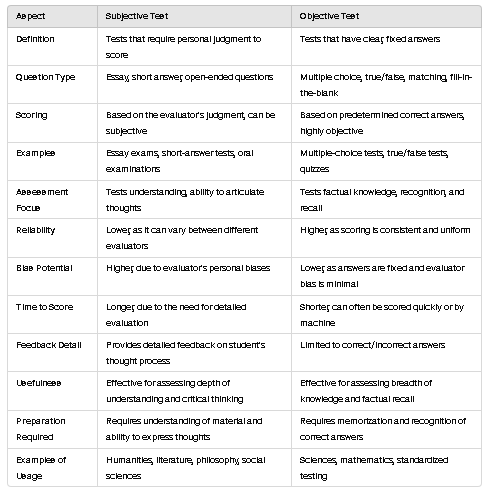
Differences between Subjective and Objective tests