Evaluating Curricular Frameworks, Assessment Methodologies, and Strategic University Pathways for 2026 and Beyond
Executive Summary & Academic Context
Selecting a high school curriculum (+2 / Pre-University level) is one of the most critical academic decisions a student makes. In 2026 and beyond, the global educational landscape values adaptability, critical thinking, technological integration, and holistic skill development. This guide offers an exhaustive, side-by-side analysis of the three premier pre-university academic pathways available to students in Nepal and globally:
- 1. International Baccalaureate Diploma Programme (IBDP): A holistic, multi-disciplinary global framework.
- 2. Cambridge International A-Levels (AS & A2): A specialized, depth-oriented British qualification.
- 3. National Examinations Board (NEB – Nepal): A nationally aligned, stream-focused competency framework.
1. Core Frameworks, Structure & Educational Philosophy
Each curriculum is built on a distinct educational philosophy designed to serve specific student goals, assessment needs, and post-secondary aspirations.
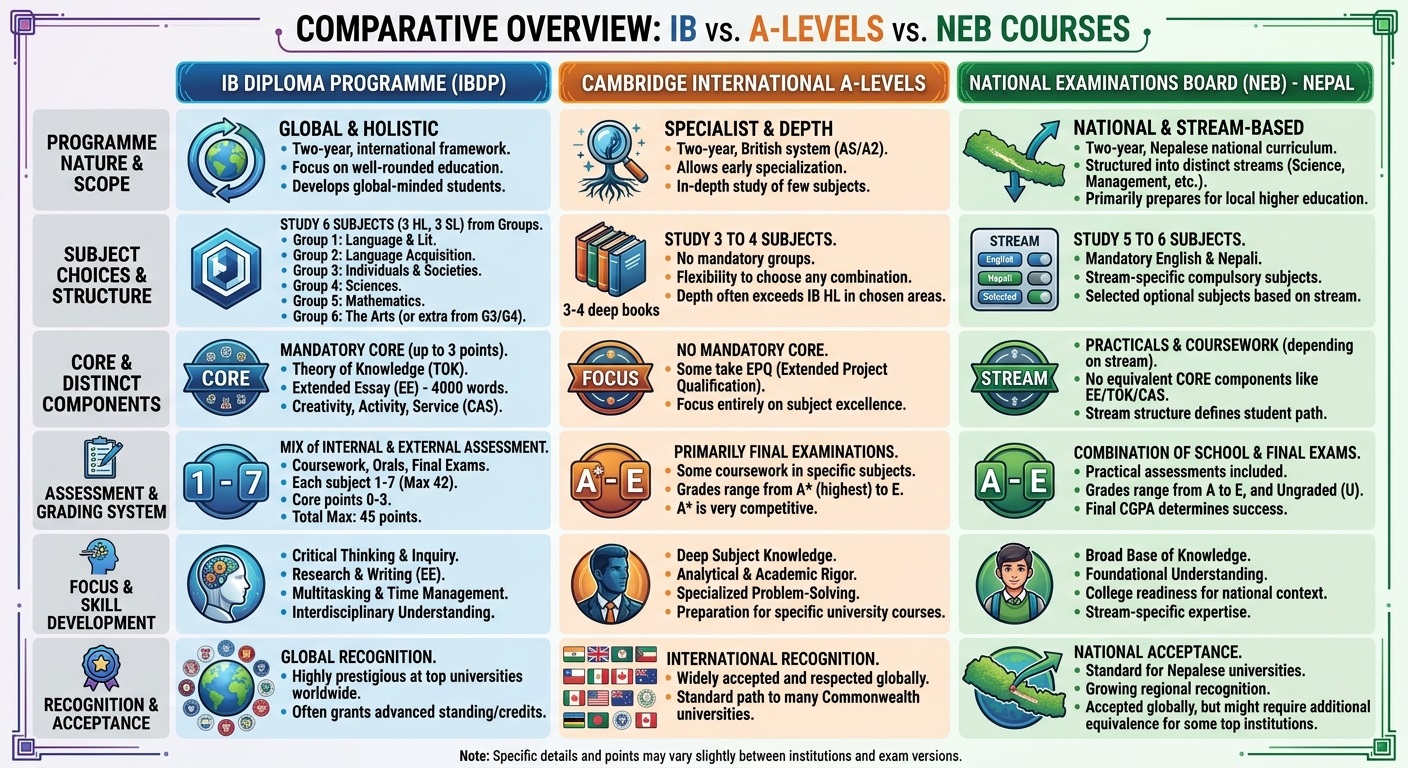
| Parameter | IB Diploma (IBDP) | Cambridge A-Levels | NEB (Nepal) |
| Governing Body | International Baccalaureate (Geneva, Switzerland) | Cambridge Assessment International Education (UK) | Ministry of Education, Science & Technology (Nepal) |
| Educational Philosophy | Interdisciplinary, holistic, and inquiry-based global learning | Subject-specialist depth, analytical mastery, and individual autonomy | Stream-based foundational knowledge & national alignment |
| Subject Load | 6 Subjects (3 Higher Level, 3 Standard Level) + 3 Core components | 3 to 4 Subjects chosen freely across any discipline | 6 Subjects (3 Compulsory + 3 Stream Electives) |
| Mandatory Core | Theory of Knowledge (TOK), Extended Essay (EE), CAS | None mandatory (Optional: Extended Project Qualification – EPQ) | Practical / Project Work (25% weightage per subject) |
| Grading System | 1 to 7 per subject + 3 Core points (Max: 45 Points) | A* to E per subject (No cumulative single score) | Letter Grading / GPA System (Max: 4.0 GPA) |
| Target Audience | All-rounders seeking global university placement & research readiness | Specialists targeting top international STEM, Law, or Business programs | Students targeting domestic medical/engineering entrances or local/global degrees |
Detailed Philosophical Breakdown
1.1 International Baccalaureate Diploma Programme (IBDP)
The IBDP operates on an interdisciplinary model designed to foster globally minded, inquiring scholars. Rather than allowing early specialization, IB mandates that students engage with subjects across languages, humanities, sciences, mathematics, and the arts. Central to the program are its three compulsory Core components:
- Theory of Knowledge (TOK): A course in epistemology challenging students to analyze how knowledge is constructed across disciplines, including digital and AI ethics.
- Extended Essay (EE): A 4,000-word independent research paper simulating university-level thesis writing under faculty supervision.
- Creativity, Activity, Service (CAS): Experiential learning requirements ensuring active engagement in creative arts, physical activities, and community service initiatives.
1.2 Cambridge International A-Levels
Cambridge A-Levels prioritize specialized academic depth and flexibility. Unencumbered by compulsory general education distribution rules, students can construct a highly targeted curriculum tailored directly to their undergraduate ambitions.
- Focused STEM Track: An aspiring engineer can take Physics, Chemistry, Mathematics, and Further Mathematics.
- Humanities & Social Sciences Track: A future legal or business scholar can combine Economics, Business, History, and English Literature.
This level of specialization allows students to master advanced university-level concepts within chosen fields, making A-Levels the preferred entry pathway for UK and Commonwealth universities.
1.3 National Examinations Board (NEB – Nepal)
Operating under Nepal’s National Curriculum Framework (NCF), NEB (Class 11 & 12) strikes a balance between standardized national education and stream-specific specialization (Science, Management, Humanities, Law, and Education). Modernized reforms have introduced a balanced 75% Theory / 25% Practical assessment structure.
- Compulsory Base: Ensures strong national language, literature, and civic understanding across all academic tracks.
- Entrance Alignment: Aligns closely with domestic competitive entrance blueprints for Medical (CEE), Engineering (IOE), and Management (KUUMAT/CMAT).
2. Assessment Dynamics, Grading Systems & 2026+ Modernization
Assessment styles vary significantly across the three boards, shaping how students learn, manage stress, and demonstrate competency.
| Dimension | IBDP | Cambridge A-Levels | NEB (Nepal) |
| Evaluation Structure | Continuous Internal Assessments (20-30%) + Final Board Exams (70-80%) | Staged Summative Examinations: AS Level (Year 1) + A2 Level (Year 2) | Final Board Theory Exam (75%) + School Internal Practical/Project (25%) |
| Exam Formats | Data analysis, essay prompts, laboratory design, oral commentaries | Structured multi-part questions, essay papers, practical lab exams | Standardized written theory papers, short/long questions, lab vivas |
| Grading Metric | Scaled points (1-7) + 3 Core points. Total out of 45. | Letter grades per subject: A*, A, B, C, D, E. | Letter Grades & Grade Point Average (GPA) up to 4.0. |
| 2026+ Modernization | Ethical AI integration into research (EE/TOK); digital portfolios | Digital / On-Screen exam options; computational subject updates | Digital grading systems, application-oriented practical project criteria |
Cognitive Development & Skill Acquisition
- Critical Research (IB Pattern): Equips students with unmatched academic research, citation mechanics, and time-management skills through concurrent coursework and core obligations.
- Subject Mastery (A-Level Pattern): Develops rigorous problem-solving capabilities, conceptual fluency, and deep domain mastery in specialized subject areas.
- Systemic Knowledge (NEB Pattern): Builds broad foundational knowledge and high-volume written examination speed suited for national standardized testing.
| 📌 2026+ Educational Trend Spotlight: Artificial Intelligence & Digital Literacy • IBDP (2026+ Framework): IB explicitly incorporates ethical AI guidelines into TOK and Extended Essay research, evaluating how students critique AI-generated outputs. • Cambridge A-Levels: Implements expanded On-Screen Digital Assessments alongside traditional papers, emphasizing computational modeling in science and math. • NEB Nepal: Integrated 25% project work emphasizing digital literacy, practical data handling, and applied problem-solving in line with national ICT benchmarks. |
3. Strategic University Pathways, Financials & Decision Matrix
Post-secondary destination goals and financial considerations are pivotal when selecting among these three curricula.
Global vs. Local University Recognition
- United States & Canada: Highly prestigious in US and Canadian holistic admissions. High Level (HL) subjects (scored 5–7) frequently earn college course credits, shortening degree duration.
- United Kingdom & Europe: A-Levels remain the gold standard (UCAS system), with offers stated in grades (e.g., A*AA). IB is universally accepted with conditional total scores (typically 36–42 points).
- Nepal & Domestic Professional Entrances: NEB provides direct, seamless alignment without requiring equivalence conversion. A-Level and IB students must obtain equivalence certificates from the Curriculum Development Centre (CDC), Sanothimi.
Comparative Cost & Infrastructure Analysis (Nepal Context)
| Parameter | IB Diploma (IBDP) | Cambridge A-Levels | NEB (Class 11 & 12) |
| Availability in Nepal | Select elite international schools (e.g., Ullens School) | Widely available across major cities (Kathmandu, Pokhara, Chitwan) | Ubiquitous nationwide across public and private colleges |
| Approx. 2-Year Tuition | NPR 15 Lakhs – 30 Lakhs+ | NPR 4 Lakhs – 12 Lakhs | NPR 1 Lakh – 4 Lakhs |
| Board Examination Fees | High (Paid in USD / CHF to IB Geneva) | Moderate-High (Paid in GBP per subject paper) | Low (Nominal fee in NPR paid to NEB Board) |
| Resource Requirements | High (Dedicated CAS leads, IB-certified faculty, specialized labs) | Moderate-High (British Council standardized science & computer labs) | Standard (Standard school laboratory and library infrastructure) |
Strategic Student Decision Profile Matrix
| 📌 Which Path Fits You Best? 1. CHOOSE IB DIPLOMA IF: • You desire a broad, well-rounded international education across STEM, humanities, and arts. • You excel at continuous coursework, research essay writing, and community service. • You target top global universities (US/Canada/Europe) with holistic admissions process. 2. CHOOSE CAMBRIDGE A-LEVELS IF: • You have clear career goals and want intense focus on 3-4 specialized subjects. • You prefer summative final examinations over continuous portfolio coursework. • You target top universities in the UK, Australia, Europe, or specialized STEM/Law programs. 3. CHOOSE NEB (NEPAL) IF: • Your primary goal is cracking Nepalese entrance exams (CEE Medical, IOE Engineering, KU, Lok Sewa). • You seek a cost-effective, globally accepted pre-university qualification. • You prefer a structured national curriculum aligned directly with local university frameworks. |
4. Conclusion & Final Recommendations
There is no universally ‘superior’ curriculum—only the pathway that best aligns with a student’s personal learning style, financial plan, and career aspirations. Students aiming for global holistic universities benefit immensely from the rigorous, multi-disciplinary IB Diploma. Those seeking deep academic specialization and flexibility find Cambridge A-Levels ideal. Finally, students aiming for domestic professional excellence in Nepal or seeking a robust, cost-effective pre-university pathway find NEB to be an optimal, highly reliable foundation.