
Unleash Your Inner Bio-Hacker: How AI is Turning Sci-Fi into Reality

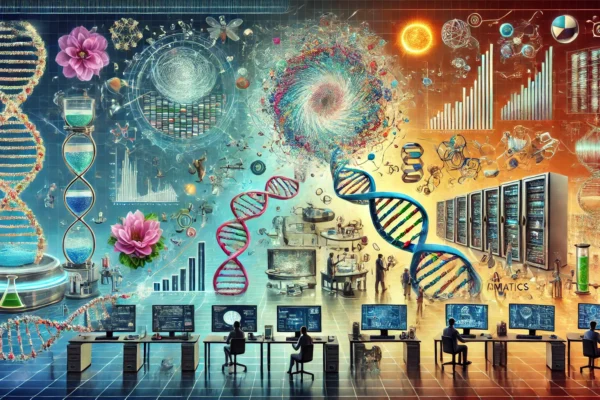
Forget everything you thought you knew about lab coats and microscopes. The most powerful tool in biotechnology today isn’t made of glass or metal—it’s made of code. A revolution is brewing at the intersection of biology and artificial intelligence, and it’s creating a new generation of digital explorers who are solving humanity’s biggest challenges from their…

Read More

Top 10 trending graduate courses for the 21st century

Top 10 trending graduate courses for the 21st century, combining high demand, future-proof skills, and industry growth: 1. Artificial Intelligence & Machine Learning (AI/ML) Why? AI is transforming healthcare, finance, and automation. Careers: AI Engineer, Data Scientist, Robotics Specialist. Top Schools: MIT, Stanford, Carnegie Mellon. 2. Data Science & Analytics Why? Businesses rely on data-driven decisions. Careers: Data Scientist, Business Analyst,…

Read More

Nepal Hosts ICBSN 2025 to Advance Biotechnology and Entrepreneurship

ICBSN 2025: Nepal Gears Up for a Landmark International Biotechnology Conference   Mukesh Yadav, Kathmandu, Nepal –1 February, 2025 Nepal is set to host a major international event in the field of biotechnology as the 3rd International Conference of the Biotechnology Society of Nepal (ICBSN 2025) brings together global experts, researchers and young innovators to…

Read More

Evolution, Current Impact and Future Potential of Bioinformatics

Bioinformatics is an interdisciplinary field that combines biology, computer science, and information technology to analyze and interpret biological data, particularly large datasets like DNA sequences, protein structures, and gene expression profiles. The evolution, current impact, and future potential of bioinformatics can be broken down as follows: 1. Evolution of Bioinformatics: Origins (1970s–1980s): Bioinformatics began in…

Read More

Antiferromagnetic materials

Antiferro magnetic material  Antiferromagnetic materials are materials where the magnetic moments of neighboring atoms align in an antiparallel fashion, resulting in no net magnetic.Here are some examples of antiferromagnetic materials: Manganese oxide (MnO), Chromium, Hematite, Iron manganese (FeMn), and Nickel oxide (NiO). Antiferromagnetic materials have several properties, including: Temperature dependence The magnetic susceptibility of antiferromagnetic…

Read More

Differences between Adsorption and Absorption

Difference between Adsorption and Absorption. Absorption 1. The process in which atoms, molecules or ions enters some bulk phase.(Liquid orsolid material) 2. It is bulk phenomenal. 3. Example :- paper or towel absorbing water, co2 form air to Naoh   Adsorption 1. The adhesion of atom, ions or molecules from gas, liquid or dissolved solid…

Read More