The study authors were amazed to find this season-sensing ability in an organism that lives for only about five hours in the lab before dividing. “It seemed like a very nonsensical idea to think that bacteria would care about something that’s happening on a scale that’s so much bigger than their lifetime,” said Luísa Jabbur, a microbial chronobiologist at the John Innes Center in Norwich, England, and lead author of the new paper.
But cyanobacteria have an evolutionary incentive to pass on relevant information to their progeny: Each cell divides into two identical clones, and each of those does as well, ad infinitum. Carl Johnson, the senior paper author at Vanderbilt University, likened it to the way monarch butterflies migrate south for the winter but never make the return journey north — their offspring do that. “When you start thinking about more of a lineage, or as the colony or population,” he said, “then that kind of thing makes perfect sense.”
The discovery connects cyanobacteria to a plethora of much more complex organisms with seasonal rhythms, and it indicates that anticipating seasons may have emerged early in life’s evolution. It may have even predated the internal clocks that give an organism a sense of day and night. “This issue of dealing with seasonality may be very fundamental to why [biological] clocks exist in the first place,” said the cell biologist Mike Rust, who studies cyanobacteria’s internal rhythms at the University of Chicago and was not involved in the new research. Staying in sync with the seasons could be more ancient and more elemental to life than anyone suspected.
How Cells Keep Time
scientists knew that circadian clocks — organisms’ internal timekeepers for the day-night cycle — are ubiquitous in multicellular plants and animals. These molecular devices choreograph delicate dances, such as plants unfolding their leaves in the morning and closing them at night. (They’re also the reason why humans have definitive sleeping and waking hours, as well as disjointed sensations when traveling between time zones or pulling an all-nighter.)
But the idea that simple organisms such as bacteria could have daily clocks as well was deemed controversial. Johnson looked into the possibility in graduate school, to no avail. Then, in 1986, evidence emerged that cyanobacteria do indeed have daily rhythms. When the South African plant physiologist Nathanaël Grobbelaar exposed cyanobacteria to light and dark periods, he observed that the cells processed nitrogen, a key nutrient, only during the simulated night. It was the first record of a day-night internal rhythm in any single-celled organism.
The discovery gave Johnson an idea: If cyanobacteria have daily rhythms, maybe he could identify the molecules that, like gears in a watch, make the organisms’ circadian clock run. In papers published in 1993 and 1998, with collaborators in Japan and Texas, he identified three genes and their corresponding proteins — KaiA, KaiB and KaiC (kai is Japanese for “cycle”) — involved with the cyanobacterial circadian clock. Interactions between KaiA and KaiB create a reaction in which KaiC acquires an extra phosphate group and then sheds it rhythmically, in sync with day and night. Astonishingly, the scientists also found that the whole loop can happen outside a cell, among loose molecules in a test tube.
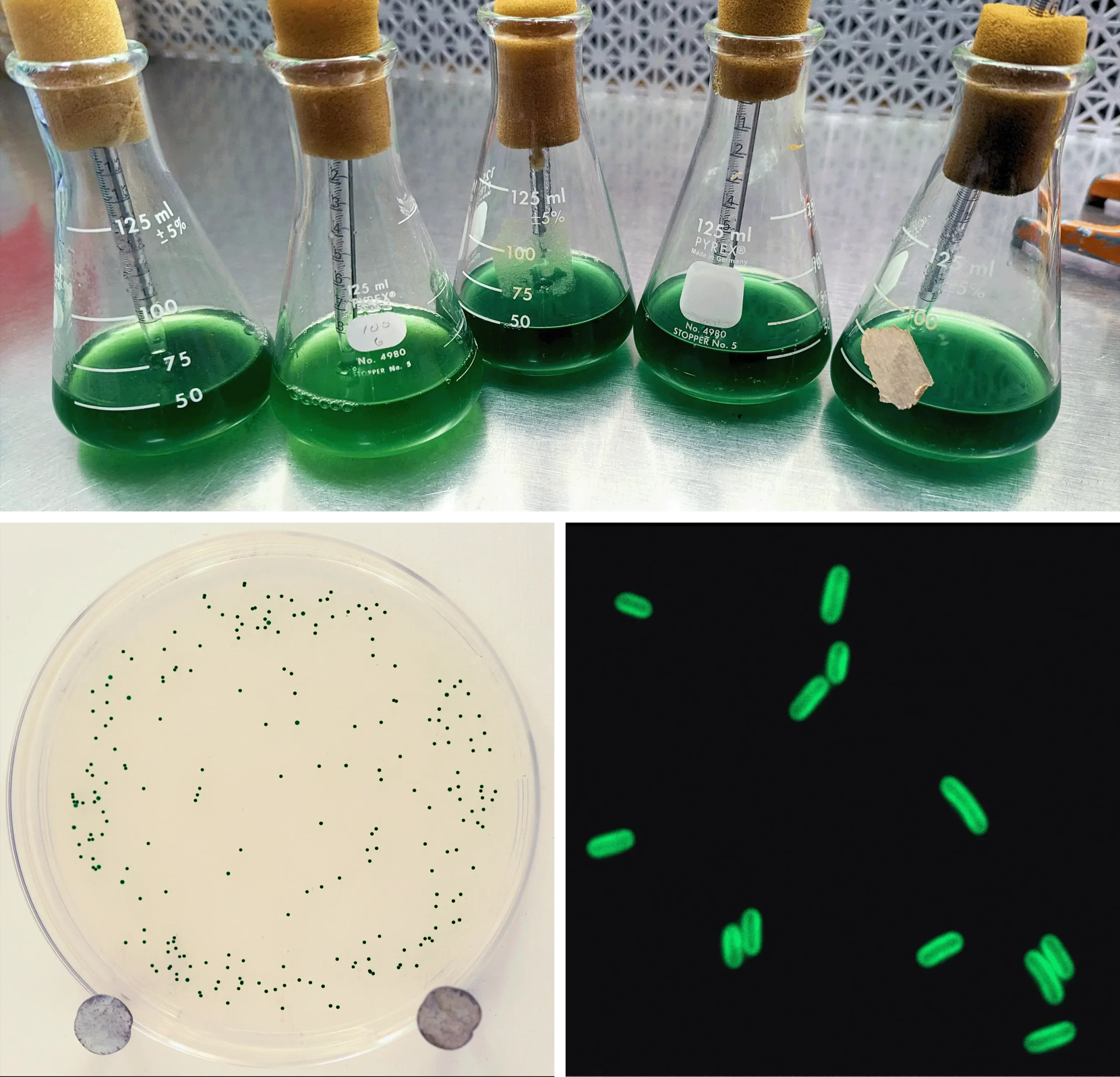
Cyanobacterial colonies pulse through a day-night cycle as a gene involved in the circadian clock cycles on and off. Biologists attached a bioluminescent reporter gene to the clock gene to visualize the rhythm of the cells’ circadian clocks. The brighter color indicates higher expression of the clock gene.
Still, these ideas remain speculative as long as photoperiodism is identified in only a single species of cyanobacteria. In her new role as a research fellow at the John Innes Center, Jabbur plans to explore the photoperiodic responses of more bacteria to better understand when this ability to anticipate seasons might have evolved. Other strains of bacteria have circadian clock genes that drive mechanisms markedly different from those of cyanobacteria. They may reveal more secrets about internal rhythms and seasonal adaptations. Only time will tell. credits to quanta science