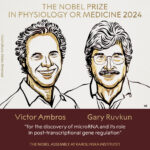
Victor Ambros and Gary Ruvkun were on Monday awarded the 2024 Nobel Prize in Physiology or Medicine for their discovery of microRNAs, a class of small molecules essential for gene regulation.
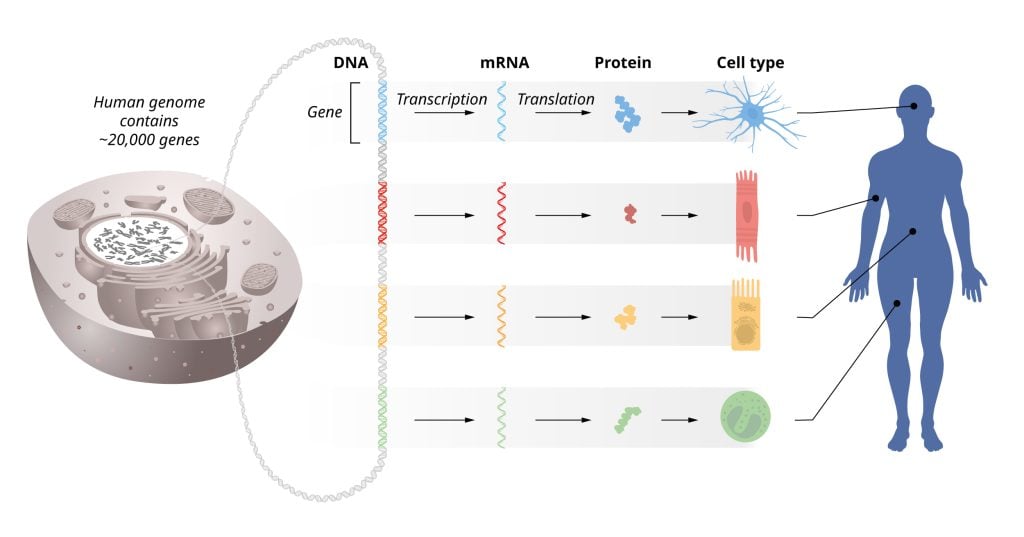
This year’s Nobel Prize focuses on the discovery of a vital regulatory mechanism used in cells to control gene activity. Genetic information flows from DNA to messenger RNA (mRNA), via a process called transcription, and then on to the cellular machinery for protein production. There, mRNAs are translated so that proteins are made according to the genetic instructions stored in DNA. Since the mid-20th century, several of the most fundamental scientific discoveries have explained how these processes work.
Our organs and tissues consist of many different cell types, all with identical genetic information stored in their DNA. However, these different cells express unique sets of proteins. How is this possible? The answer lies in the precise regulation of gene activity so that only the correct set of genes is active in each specific cell type. This enables, for example, muscle cells, intestinal cells, and different types of nerve cells to perform their specialized functions. In addition, gene activity must be continually fine-tuned to adapt cellular functions to changing conditions in our bodies and environment. If gene regulation goes awry, it can lead to serious diseases such as cancer, diabetes, or autoimmunity. Therefore, understanding the regulation of gene activity has been an important goal for many decades.
In the 1960s, it was shown that specialized proteins, known as transcription factors, can bind to specific regions in DNA and control the flow of genetic information by determining which mRNAs are produced. Since then, thousands of transcription factors have been identified, and for a long time it was believed that the main principles of gene regulation had been solved. However, in 1993, this year’s Nobel laureates published unexpected findings describing a new level of gene regulation, which turned out to be highly significant and conserved throughout evolution.
Victor Ambrose: A Visionary in Biotechnology
Victor Ambrose, an accomplished scientist, is recognized for his pioneering work in RNA technology. His research has played a critical role in understanding gene expression and regulation, laying the groundwork for mRNA vaccines. Ambrose’s innovative approach has transformed the landscape of vaccine development, especially in response to global health crises.
One of his notable contributions includes the development of a platform that enables rapid mRNA synthesis. This technology was crucial during the COVID-19 pandemic, allowing for the swift creation of vaccines. His commitment to using science for public good is reflected in his advocacy for accessible healthcare solutions worldwide.
Gary Livkun: A Leader in Genomic Research
Gary Livkun complements Ambrose’s efforts with his expertise in genomics. His research focuses on the intricate relationships between genes and their expressions, providing insights into complex biological processes. Livkun’s work has been instrumental in advancing genomic editing technologies, such as CRISPR, which hold promise for treating genetic disorders and enhancing crop resilience.
Livkun’s dedication to education and mentorship has also made a lasting impact. He has guided numerous young scientists, fostering a new generation of innovators committed to ethical scientific practices.
Collaborative Achievements
The partnership between Ambrose and Livkun has resulted in significant breakthroughs in both human health and agricultural sustainability. Their joint research projects have explored the potential of RNA interference in controlling plant diseases and improving crop yields. By integrating their expertise, they have created innovative solutions that address food security challenges while minimizing environmental impact.
Their collaborative paper on RNA-based therapeutics not only garnered attention in scientific communities but also laid the groundwork for future studies exploring the therapeutic potential of RNA in various diseases.
Recognition and Legacy
In recognition of their groundbreaking contributions, Ambrose and Livkun were awarded the Nobel Prize in Physiology or Medicine. This honor not only celebrates their achievements but also highlights the importance of interdisciplinary collaboration in scientific research. Their legacy continues to inspire researchers and students, emphasizing the transformative power of innovation in addressing global challenges.
Conclusion
Victor Ambrose and Gary Livkun exemplify the spirit of scientific inquiry and collaboration. Their work has not only advanced our understanding of biology but also paved the way for practical solutions that can benefit humanity. As they continue to explore new frontiers in biotechnology and genomics, their influence will undoubtedly shape the future of science and medicine for generations to come.