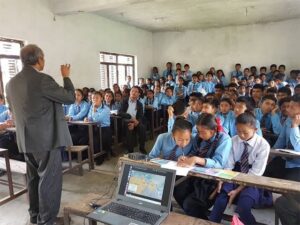
“Let Nepal’s classrooms ignite a revolution of learning, blending heritage with innovation, to forge a nation where every mind shines as a global beacon of prosperity.”
Nepal’s education sector stands at a critical juncture, grappling with systemic inefficiencies that stifle progress while holding untapped potential to become a global hub for learning. The School Education Bill, languishing in parliamentary debates since September 2023, has sparked protests from public school teachers demanding reforms. Yet, the discourse remains trapped in administrative wrangles dividing responsibilities among federal, provincial, and local governments while sidelining the urgent need for a transformative educational vision. As an independent writer and passionate advocate for education, I propose a bold, solutions-driven strategy to address Nepal’s challenges, elevate educational quality, and position the nation as a beacon of innovation and prosperity.
The Crisis in Context
Nepal’s education system faces intertwined challenges:
– Stagnant Quality: Despite near-universal primary enrollment (95%), learning outcomes are dismal. Around 30% of public school teachers lack formal training, leaving students struggling with basic literacy and numeracy.
– Infrastructure Gaps: Rural schools often lack electricity, clean water, or digital tools, isolating them from modern learning.
– Outdated Curriculum: The current syllabus emphasizes rote learning, neglecting critical thinking, digital literacy, and global competitiveness.
– Brain Drain: Growing numbers of students pursue education abroad due to limited opportunities and subpar quality, draining resources and talent.
– Public-Private Divide: Private schools outperform public ones, but access is unequal, and perceptions of commercialization fuel distrust.
These issues, compounded by political instability and underfunding (education receives ~14% of the national budget, below UNESCO’s 20% recommendation), demand urgent action. However, Nepal’s strategic location, youthful population (40% under 24), and cultural resilience offer a foundation for bold reform.
A Vision for Transformation
To address these challenges and establish Nepal as a global education hub, I propose a multi-pronged strategy rooted in innovation, inclusivity, and international alignment.
1. Modernize the Curriculum for Global Relevance
Challenge: Nepal’s curriculum is outdated, disconnected from the needs of a tech-driven, globalized economy.
Solution:
– Integrate International Baccalaureate (IB), Cambridge, or STEM-focused frameworks at the school level, emphasizing critical thinking, creativity, and digital fluency.
– Embed vocational training (coding, renewable energy, agribusiness) from grade 8 to align with local and global job markets.
– Develop bilingual curricula (Nepali/English) to preserve cultural identity while ensuring global accessibility.
– Pilot AI-driven adaptive learning platforms in urban schools, scaling to rural areas by 2030.
Impact: Produces graduates ready for global competition, reducing reliance on foreign education.
2. Bridge the Public-Private Divide Through Collaboration
Challenge: Public schools lag in quality, while private schools face accusations of profiteering.
Solution:
– Establish Public-Private Partnerships (PPPs) to share resources, such as teacher training programs and digital infrastructure.
– Incentivize private schools to offer scholarships (minimum 20% of seats) for marginalized students through tax breaks.
– Create a National Education Innovation Fund, pooling contributions from private institutions and diaspora remittances to upgrade public schools.
– Form joint task forces of public and private educators to design scalable teaching models.
Impact: Reduces inequality, fosters trust, and elevates overall standards.
3. Empower Teachers as Catalysts of Change
Challenge: Untrained teachers and low morale hinder quality delivery.
Solution:
– Launch a National Teacher Training Academy with mandatory certifications in modern pedagogy, digital tools, and inclusive education.
– Offer performance-based incentives (e.g., salary hikes, sabbaticals) to retain talent in public schools.
– Partner with global platforms like Coursera or edX for continuous professional development, targeting 100% trained teachers by 2035.
– Introduce mentorship programs pairing experienced private school educators with public school counterparts.
Impact: Creates a skilled, motivated teaching force, directly boosting student outcomes.
4. Build a Digital-First Education Ecosystem
Challenge: Digital literacy is abysmal, and rural schools lack tech infrastructure.
Solution:
– Roll out a Digital Nepal Education Initiative, providing solar-powered computer labs and high-speed internet to 50% of rural schools by 2030.
– Develop a National Open Education Platform with free access to e-textbooks, video lectures, and skill-based courses in multiple languages.
– Train students in coding and data literacy from grade 5, aligning with global tech demands.
– Partner with tech giants (e.g., Google, Microsoft) to subsidize devices and cloud infrastructure.
Impact: Democratizes access, equips students for the 21st-century economy, and attracts global edtech investment.
5. Align Education with Employment
Challenge: Graduates face unemployment due to a skills-jobs mismatch.
Solution:
– Establish Industry-Academia Councils to align curricula with sectors like tourism, hydropower, and IT, Nepal’s economic pillars.
– Mandate internships for high school and university students, leveraging partnerships with local and international firms.
– Create Entrepreneurship Incubators in schools, offering micro-grants for student-led startups in agriculture, tech, and crafts.
– Promote freelancing skills (e.g., digital marketing, graphic design) to tap into the global gig economy.
Impact: Reduces unemployment, fosters innovation, and retains talent domestically.
6. Position Nepal as a Global Education Hub
Challenge: Nepal is absent from the global education map, losing students and revenue to foreign institutions.
Solution:
– Develop International Education Zones in cities like Kathmandu, Pokhara, and Biratnagar, offering IB, Cambridge, and STEM programs at competitive costs.
– Attract foreign universities to set up satellite campuses through tax incentives and streamlined regulations.
– Market Nepal as a study-abroad destination, leveraging its cultural heritage, affordability, and Himalayan appeal.
– Create a Nepal Education Export Council to promote Nepali institutions globally, targeting 50,000 international students by 2040.
Impact: Generates revenue, reverses brain drain, and elevates Nepal’s global standing.
7. Secure Sustainable Funding
Challenge: Chronic underfunding limits reform scalability.
Solution:
– Increase education’s budget allocation to 20% of GDP by 2030, prioritizing infrastructure and teacher salaries.
– Introduce a National Education Cess (1% on luxury goods) to fund rural schools.
– Tap diaspora bonds to channel remittances into education projects.
– Seek grants from multilateral agencies (e.g., World Bank, ADB) for tech and vocational programs.
Impact: Ensures long-term financial stability for ambitious reforms.
Overcoming Resistance
Reforms will face pushback from entrenched interests, bureaucratic inertia, and cultural conservatism. To navigate this:
– Engage Stakeholders: Hold transparent consultations with teachers’ unions, private institutions, and parents to build consensus.
– Pilot Projects: Test reforms in select districts (e.g., Chitwan, Kaski) to demonstrate success before scaling.
– Leverage Political Will: With the UML-Congress coalition in power, advocate for education as a national priority in the 2025 budget.
– Counter Cultural Concerns: Highlight how global curricula can integrate Nepali values, using examples like Bhutan’s balanced approach.
Measuring Success
To ensure accountability, establish Key Performance Indicators (KPIs):
– Increase public school teacher training coverage to 80% by 2030.
– Achieve 50% digital literacy among students by 2035.
– Reduce secondary dropout rates from 15% to 5% by 2030.
– Enroll 10,000 international students annually by 2035.
– Boost education’s GDP contribution to 5% through exports by 2040.
The Bigger Picture
A revitalized education system will catalyze Nepal’s prosperity by:
– Driving Economic Growth: Skilled graduates will fuel industries like IT, tourism, and green energy, reducing reliance on remittances (12% of GDP).
– Reducing Inequality: Inclusive reforms will empower marginalized groups, narrowing urban-rural and gender gaps.
– Enhancing Global Influence: As an education hub, Nepal can lead South Asia in innovative pedagogy, rivaling Singapore or Finland.
– Fostering Resilience: Educated citizens will better navigate crises, from natural disasters to economic shocks.
The School Education Bill is a chance to redefine Nepal’s future, not just resolve administrative disputes. The government must act decisively, collaborating with private players, educators, and global partners. As a nation, Nepal can transform its challenges into opportunities, building an education system that not only serves its people but inspires the world. Let’s seize this moment to create a legacy of learning, innovation, and prosperity for generations to come.
A colossal thank-you for diving into my wild dream to turbocharge Nepal’s education system, your eyeballs just joined the revolution, and I’m tickled pink!