Unlocking the Secrets of Gene Regulation and Inspiring Future Innovators in Science
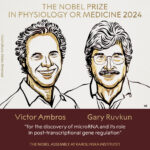
The Nobel Assembly at the Karolinska Institute has awarded the 2024 Nobel Prize in Physiology or Medicine to Victor Ambros and Gary Ruvkun for their revolutionary discovery of microRNA and its essential role in post-transcriptional gene regulation. This year’s Nobel Prize celebrates two brilliant scientists who uncovered a fundamental mechanism that governs how our genes are regulated, paving the way for a deeper understanding of life itself.
Gene Regulation: The Key to Cellular Diversity
Think of the chromosomes in our cells as an instruction manual that contains all the information needed to build and run the human body. Every single cell carries the same set of genes, yet the body is made up of diverse cell types—like muscle, nerve, and blood cells—all with different functions. How can this be? The answer lies in gene regulation. It’s a highly specialized process that ensures each cell activates only the genes it needs, based on its specific role in the body. This precise regulation is what makes cells so unique and essential to life.
MicroRNA: A Groundbreaking Discovery
Victor Ambros and Gary Ruvkun wanted to understand how cells evolve into different types. In their research, they uncovered a previously unknown class of tiny RNA molecules, called microRNA, that play a crucial role in regulating gene activity. This discovery was completely unexpected and revealed a new principle in biology—microRNAs control which genes are turned on or off. Their work is now known to be essential for all multicellular organisms, including humans, as over one thousand microRNAs are coded by the human genome. This breakthrough has transformed our understanding of how organisms grow, function, and adapt.
A Message to Future Innovators: Your Potential is Limitless
The discovery of microRNA has opened a new dimension in biology, showing us that even the tiniest molecules can have a massive impact on life. It highlights how exploration, curiosity, and perseverance in science can lead to groundbreaking innovations that benefit humanity. For young minds passionate about science, the possibilities are endless. The next breakthrough that could transform human health, protect nature, or advance sustainable living may come from your own hands.
Ambros and Ruvkun’s discovery serves as an inspiration to think boldly, question the unknown, and pursue excellence in science. With determination, you can be part of the next generation of pioneers shaping a better future—making life easier, conserving natural beauty, and creating harmony between humans and the environment.
Explore more:
– [Press release](https://bit.ly/3BiM2o9)
– [Advanced information](https://bit.ly/3N6vAtK)